
Global Summit Coordination Platform
From spreadsheets, calls and scattered chats to one coordinated view of every meeting.
- Role
- Product Designer
- Duration
- 2 months
- Team
- Solo Designer
- Platform
- Desktop web
- Status
- Completed
- Tools
- Figma, FigJam, AI-assisted wireframing
Verified outcome
A scalable coordination system that brought principal management, liaison workflows, meetings, scheduling and alerts into one place.
Problem / Opportunity
The problem worth solving
Meeting coordination for a large international summit lived across spreadsheets, phone calls and messaging apps, leaving no shared view of principals, schedules or assignments.
The people most affected
- Liaison Officers
- Chief Liaison Officers
- Organising Teams
- Support Staff
Project snapshot
Scope and responsibility
- Domain
- B2B
- Product type
- SaaS / Web Platform
- Market
- International summit operations
- Primary user
- Liaison Officers and Chief Liaison Officers
- Role
- Product Designer
- Status
- Completed
Project context
What existed before
- Meeting requests arrived through calls and messaging apps.
- Schedules and assignments were tracked in spreadsheets.
- Status changes were communicated person to person.
Information was fragmented across channels, so no one had a reliable picture of what was actually scheduled or who was responsible.
What triggered the work
A large-scale international summit where multiple principals, meetings, schedules, assignments and teams had to be coordinated at the same time.
Users & context
Understanding the users
Users
Liaison Officers, Chief Liaison Officers, Organising Teams, Support Staff
Age / context
Approximately 25–55
Environment
Large-scale international summit and event operations
Primary device
Desktop / laptop
Digital familiarity
Moderate to high
Domain
Event operations and high-level meeting coordination
Research / Evidence
What informed the direction
Direction was validated with the organising stakeholders through workflow mapping and wireframe reviews. Formal user research sessions were not part of this engagement.
Evidence is reported exactly as available; research interviews are not presented as usability testing.
User flow
How the product works
Core journey
- 1A meeting request is raised for a principal.
- 2Availability is checked against existing commitments.
- 3A liaison officer is assigned and confirms the request.
- 4The schedule updates and affected teams are alerted.
- 5Status is tracked through to completion and reporting.
What was simplified
- Meeting requests
- Schedules
- Assignments
- Alerts
- Meeting statuses
The main structural decision was to make the schedule the single source of truth, with requests, assignments and alerts all resolving into it.
User experience & trust
How the experience should feel
Before
- Uncertainty about whether a change had reached everyone
- Pressure from high-stakes, time-critical meetings
- Low confidence in the accuracy of shared documents
Experience goals
Dense but quiet information design: clear status language, visible ownership on every record, and alerts tied to the exact meeting that changed.
User behaviour
How the design supports user behaviour
- 1Coordinator checks the schedule for the day
- 2Acts on requests, conflicts and assignment gaps
- 3System reflects the change immediately
- 4Stakeholders see an accurate view and stop re-confirming by phone
The behaviour the product tries to change is the habit of verifying information over calls and chats because the shared record is not trusted.
Opportunity
How might we…
How might we give every stakeholder one trustworthy view of the meeting schedule?
How might we make availability visible before a meeting is requested?
How might we make changes traceable without extra reporting work?
Prioritisation
Prioritising features for the first release
MVP
- Principal and assignment management
- Meeting request and approval flow
- Central schedule with status tracking
Next
- Alerts and change notifications
- Operational reporting views
Later
- Deeper analytics
- Cross-event templates
Design process
From discovery to delivery
- 1Problem framing with the organising team
- 2Mapping existing coordination workflows
- 3Information architecture for principals, meetings and assignments
- 4AI-assisted wireframes to validate direction quickly with stakeholders
- 5End-to-end flows for requests, scheduling and alerts
- 6High-fidelity interface design
- 7Developer handoff
Key decisions
The choices that shaped the product
One schedule, many entry points
Rather than separate tools for requests, assignments and calendars, every action resolves into a single schedule so there is one version of the truth.
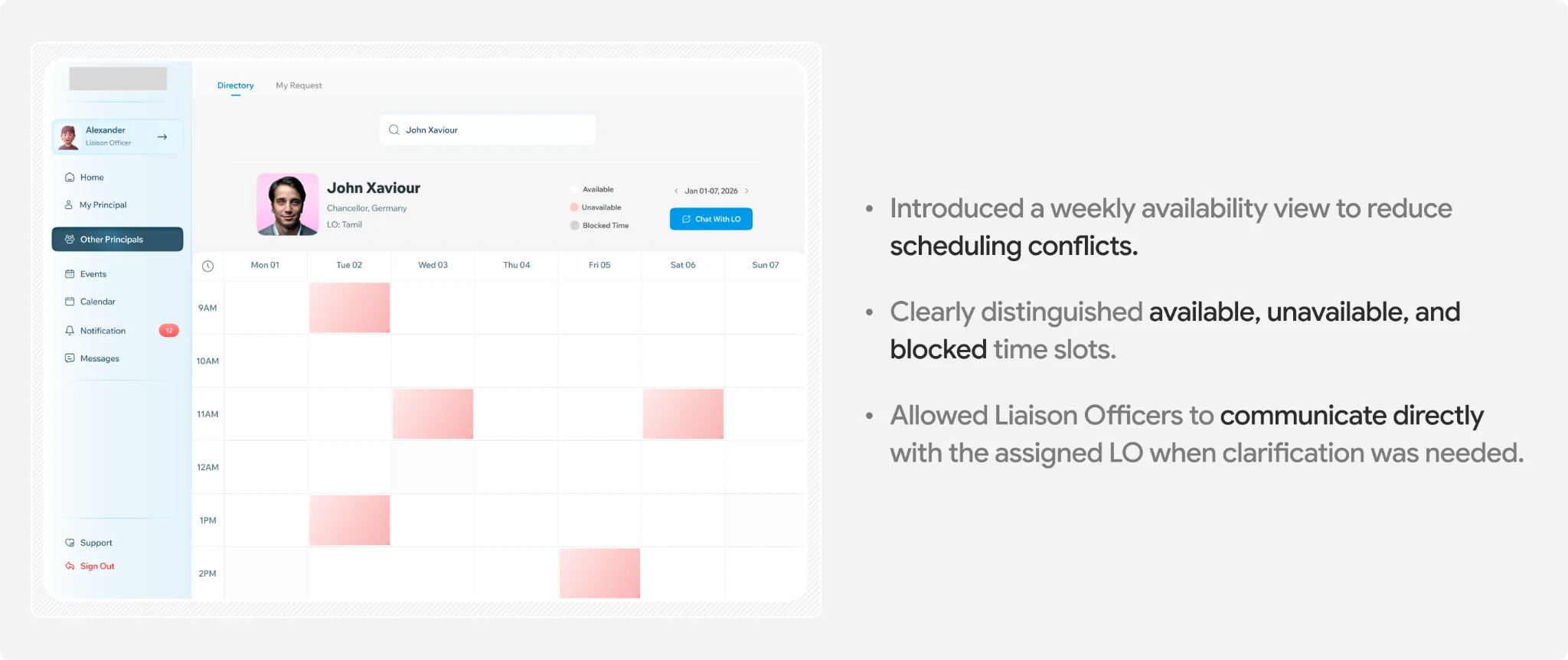
Availability shown at the point of request
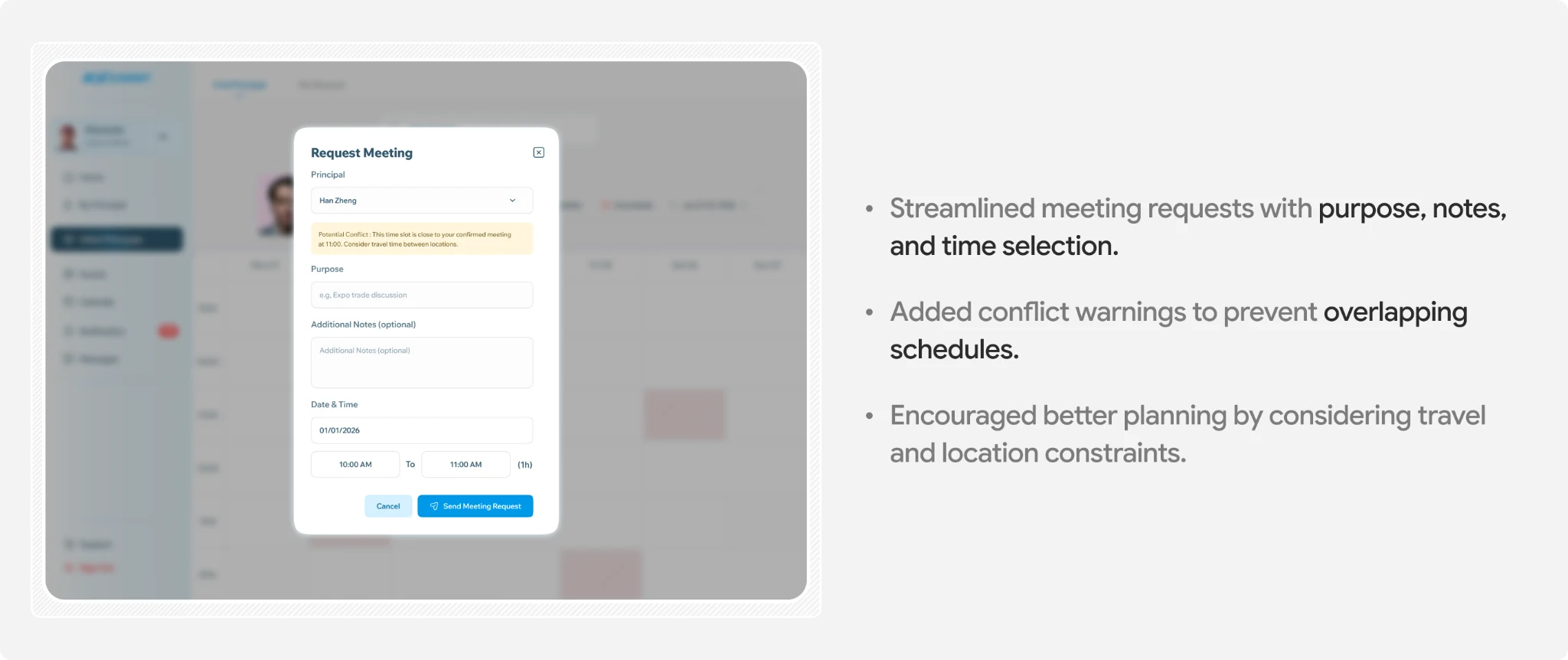
Conflicts were the most expensive failure, so availability context appears while a request is being made, not after it is submitted.
Status as plain language
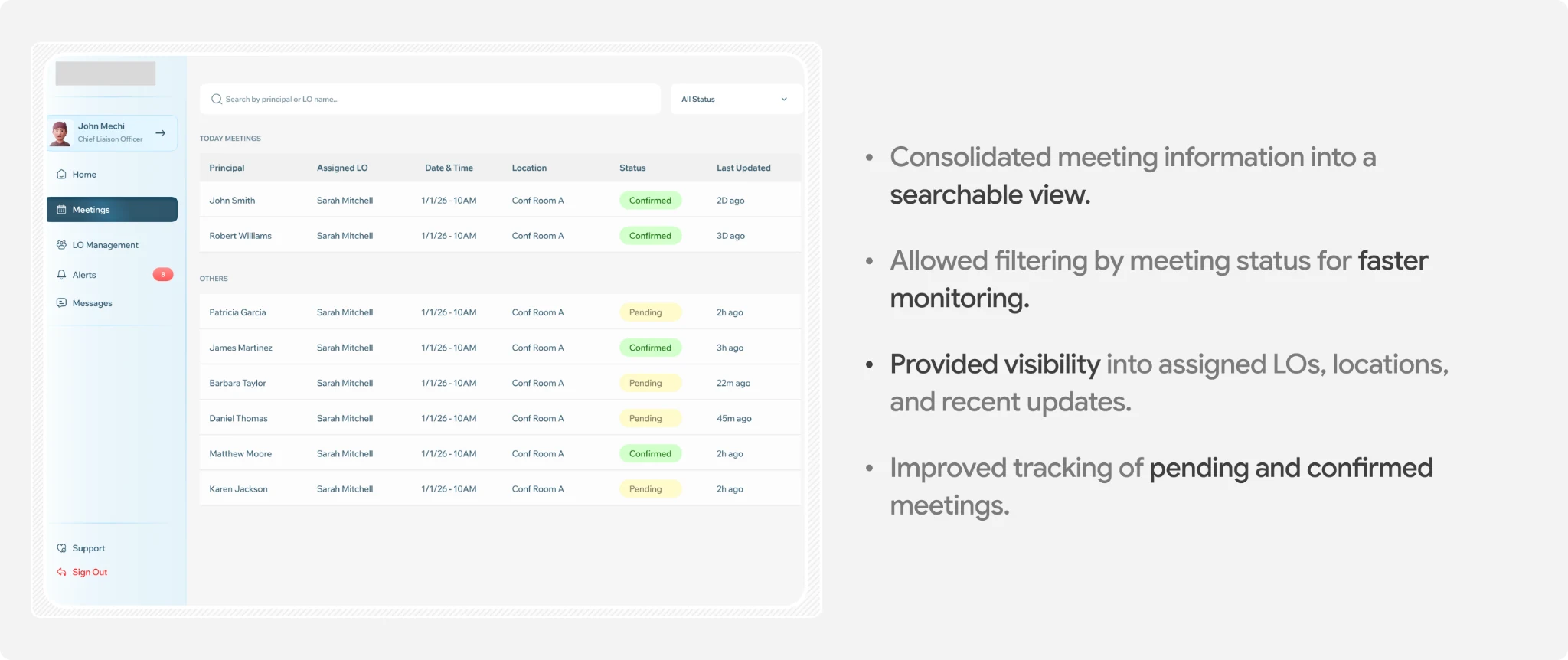
Meeting states use operational language the teams already used, which reduced the amount of training needed during a fast-moving event.
AI-assisted wireframes for stakeholder alignment
Early low-fidelity direction was produced quickly so stakeholders could react to something concrete before detailed design began.
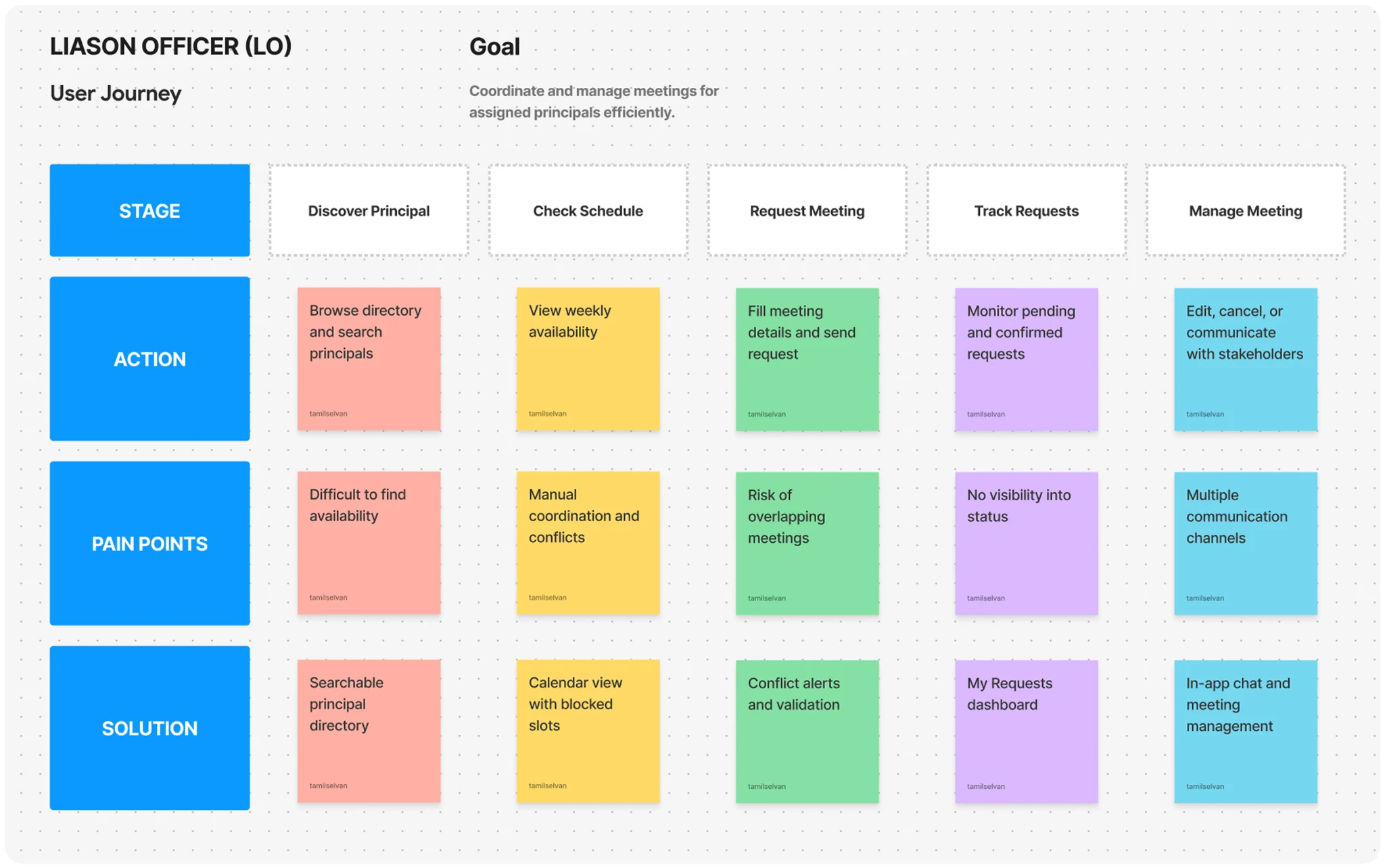
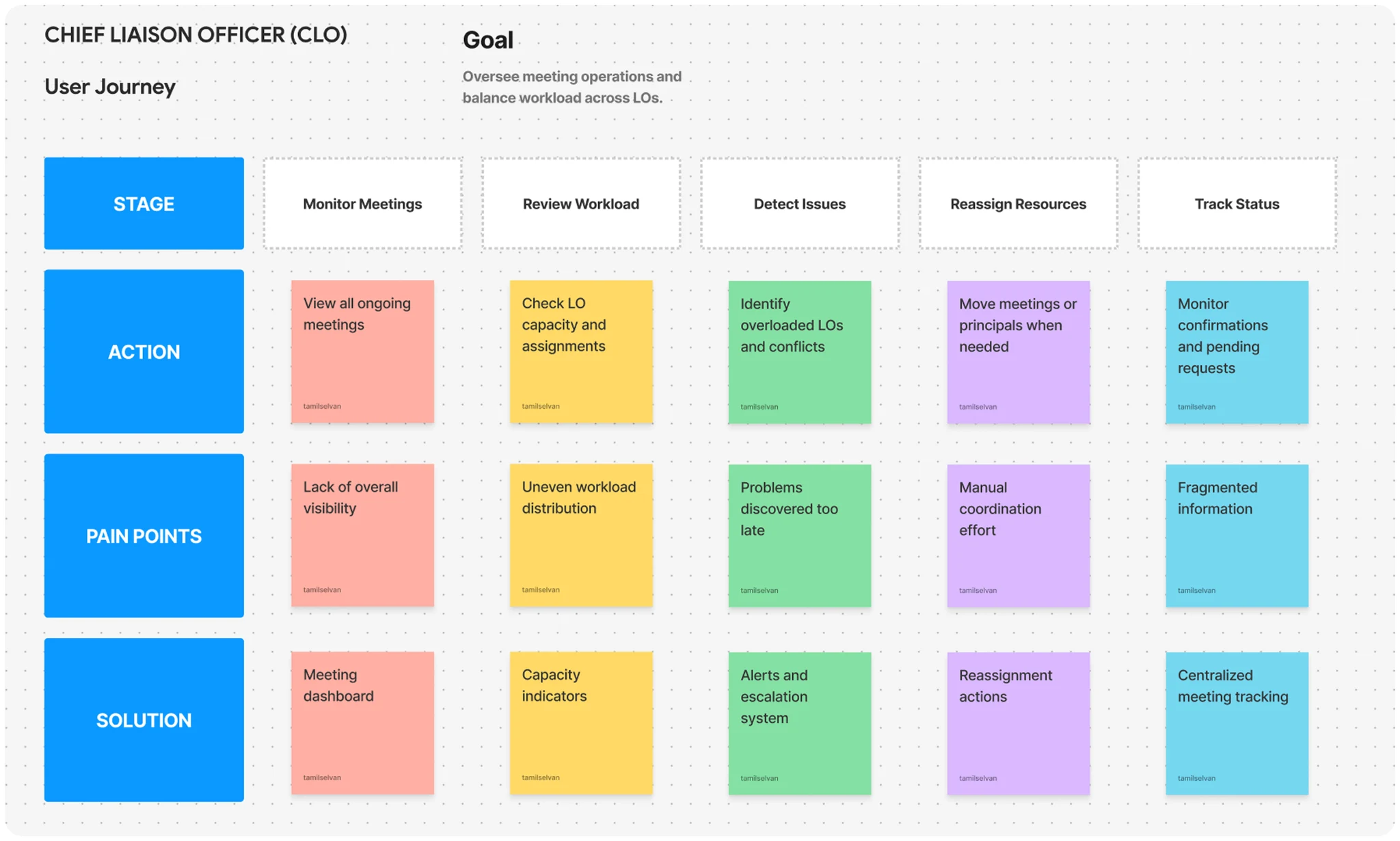
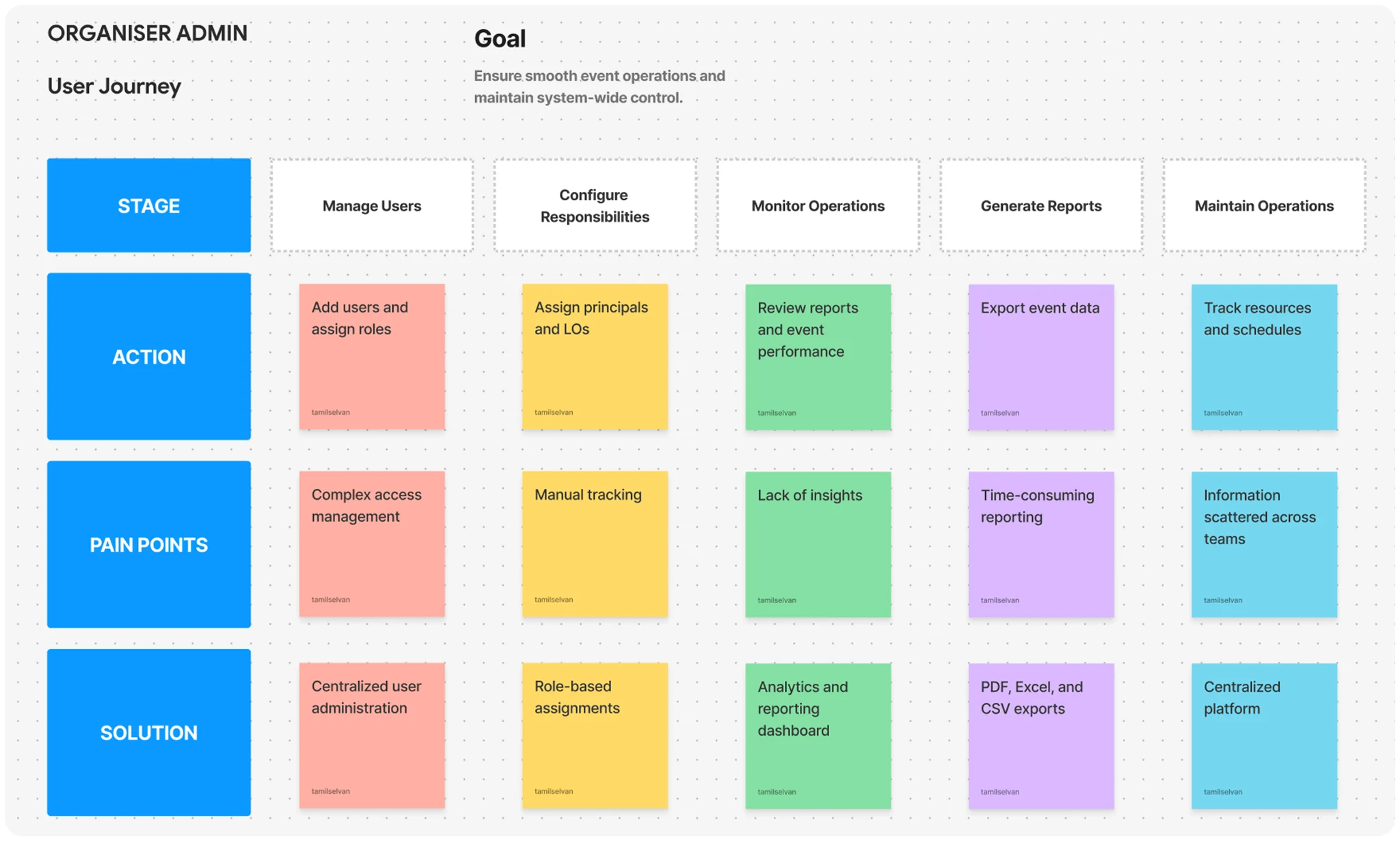
User journeys
Coordinating meetings across roles
Wireframes / Exploration
Exploring the design
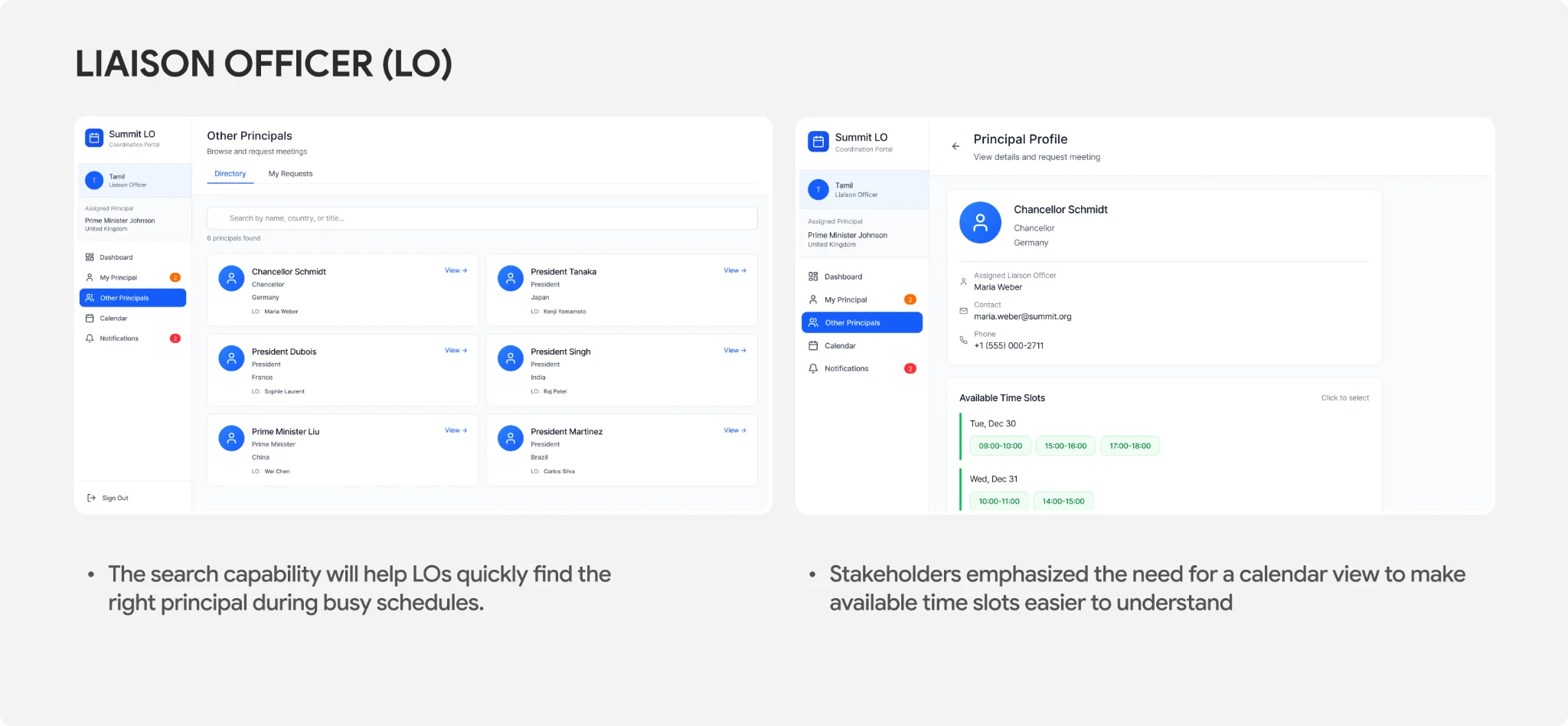
Final solution
The final design
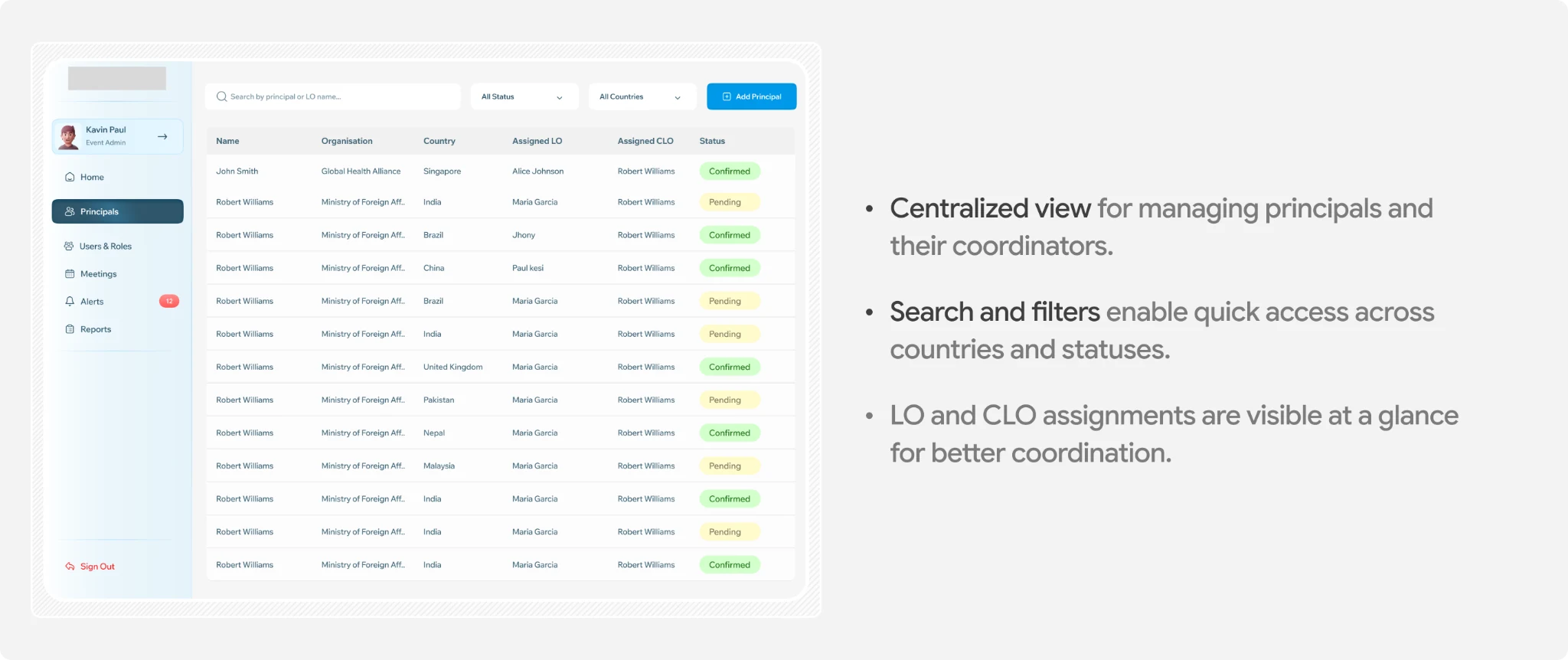
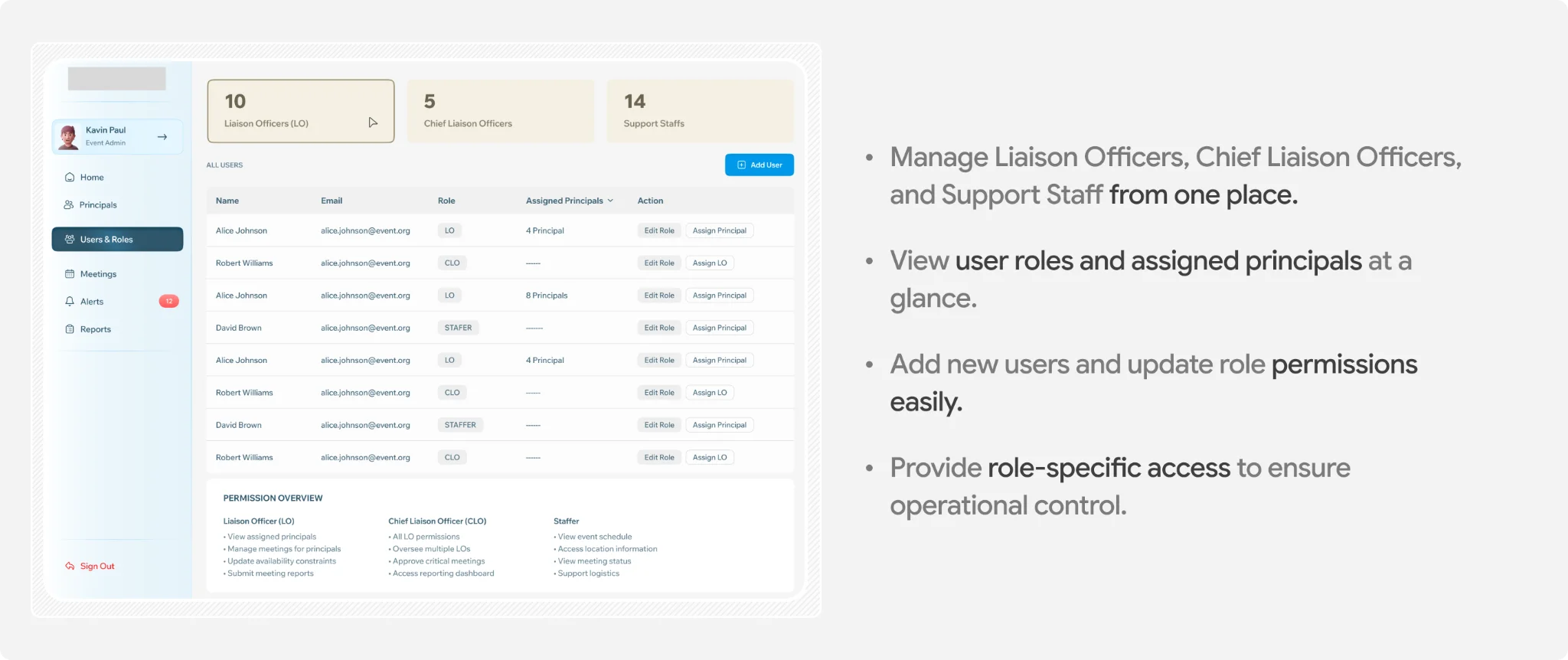
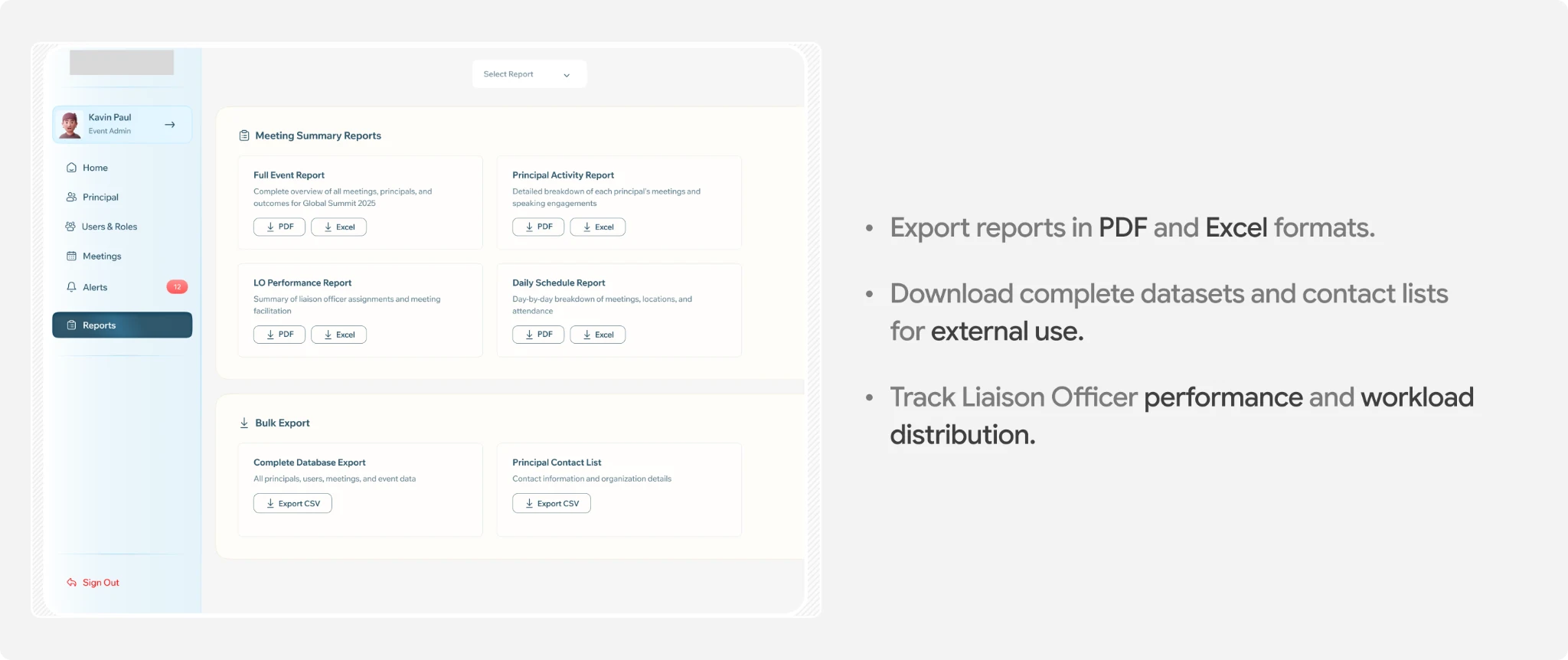
A scalable coordination system that brought principal management, liaison workflows, meetings, scheduling and alerts into one place.
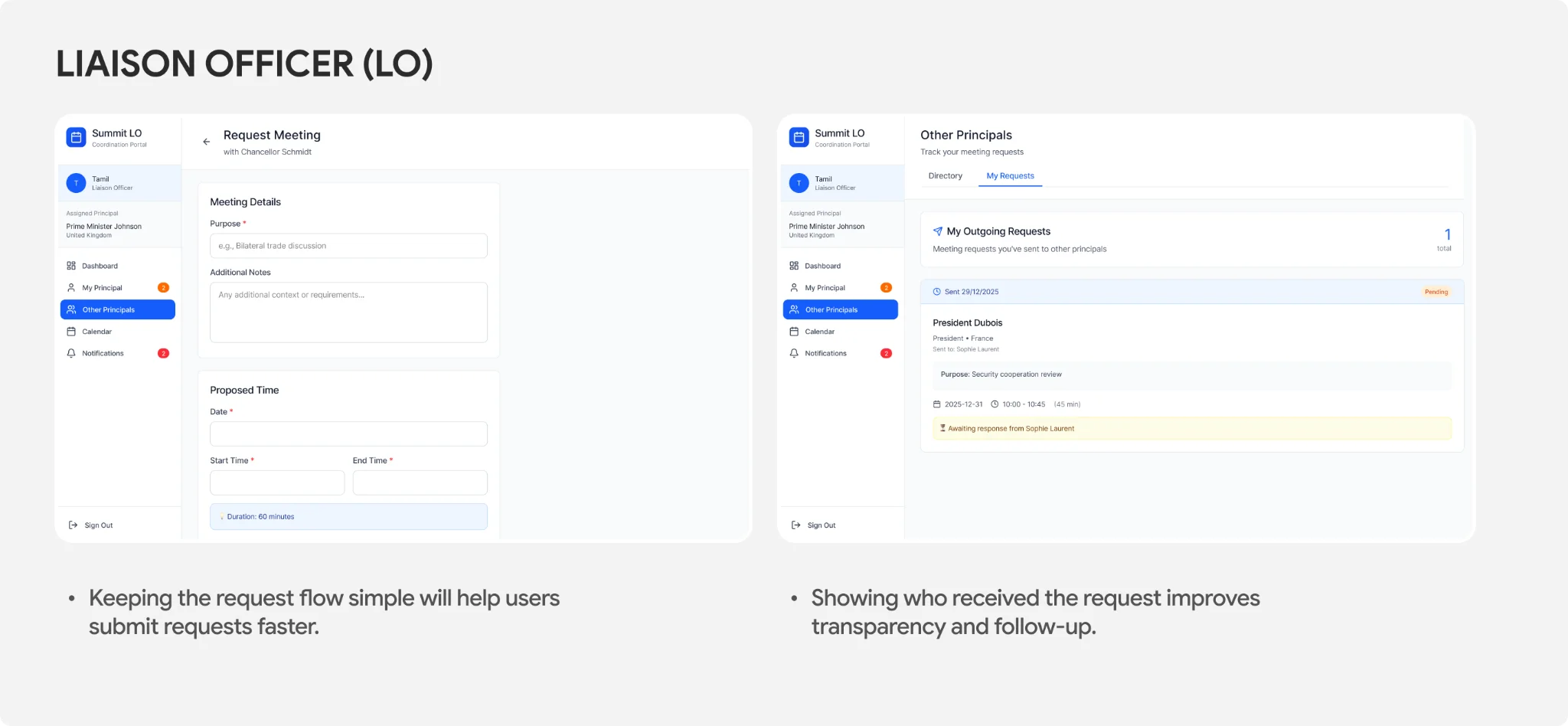
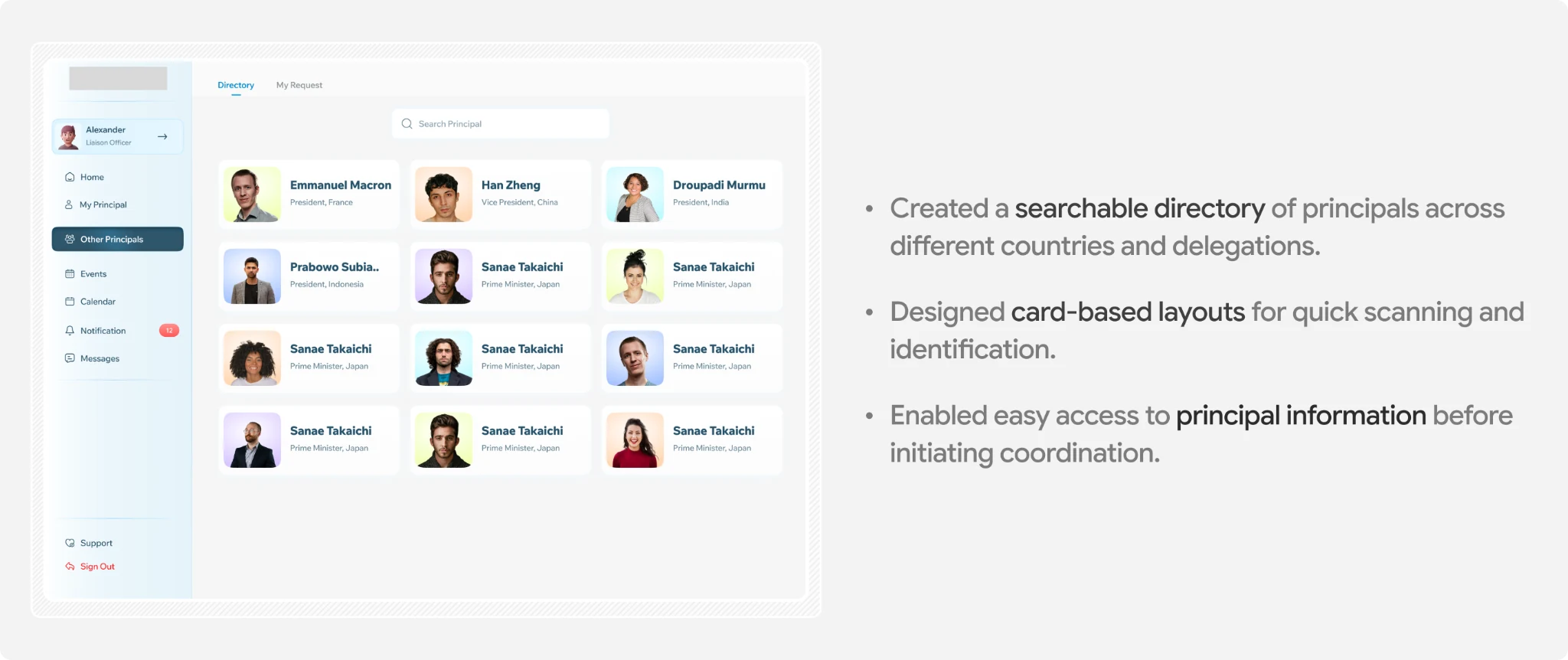
LIAISON OFFICER (LO)
Goal: Efficiently manage meetings for assigned principals and handle scheduling requests.

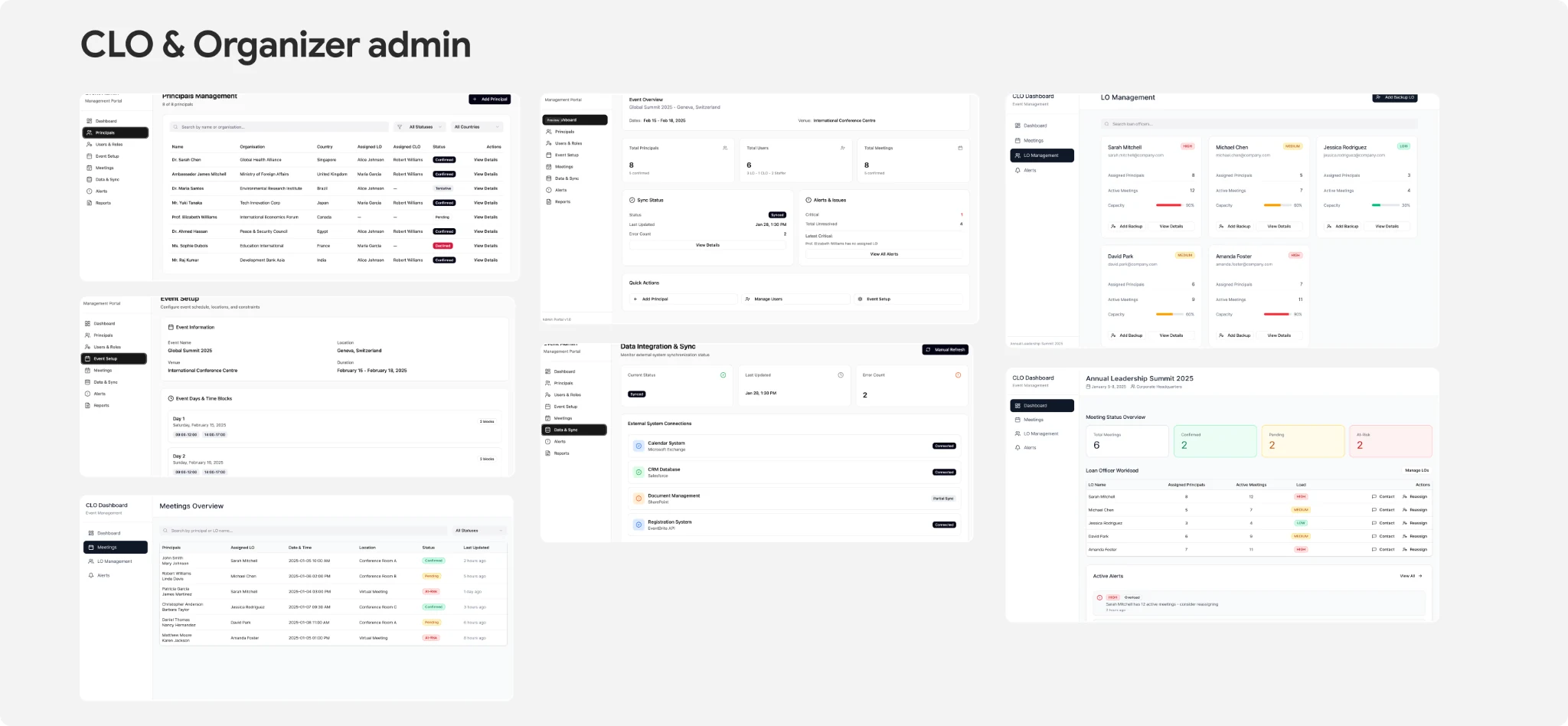
CHIEF LIAISON OFFICER (CLO)
ORGANISER ADMIN
Validation & Success Measures
The platform was designed and developed but paused before launch due to business priorities. Therefore, post-launch behavioural metrics were not available.
Stakeholder validation
✓ Validated
Early concepts reviewed with the client and refined based on feedback
Core workflows
✓ Delivered
LO, CLO and Organising Team workflows designed end-to-end
Design coverage
✓ Delivered
Meeting requests, scheduling, assignments, alerts and reporting covered
Expected Impact
Proposed success targets to validate after launch; these are not measured outcomes.
Reduce reliance on manual tools
Target: replace 70–80% of WhatsApp messages, calls, and spreadsheet updates with structured in-platform actions.
Improve visibility
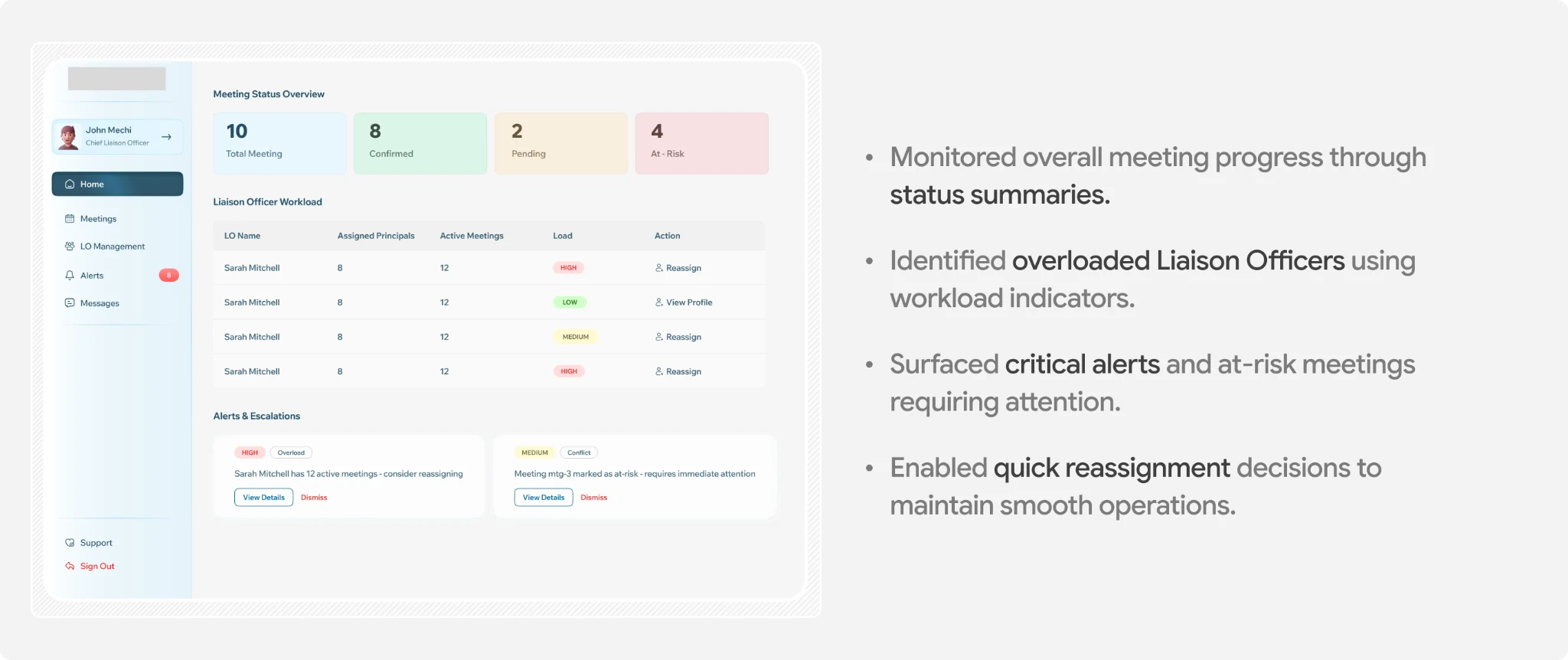
Target: reduce the CLO’s time to assess full-team status from an estimated 15–20 minutes to under 2 minutes through a single dashboard.
STAR summary
The project in four parts
situation
The event team was coordinating high-stakes meetings between international principals and liaison officers across multiple stakeholders, making coordination difficult to track.
task
Create a centralized platform that simplified meeting coordination, assignments, scheduling and operational visibility.
action
Designed the platform end-to-end across principal management, liaison workflows, meetings, scheduling, alerts and reporting. AI-assisted wireframes were used to validate direction with stakeholders before moving into final design.
result
Created a scalable coordination system that brought important operational workflows into one place and improved visibility across principals, liaison officers, meetings and event operations.
Design impact
Before and after the redesign
Before
Requests arrived by call and chat
Intervention
A structured request and approval flow
After
Every request is recorded against a principal and a schedule
Before
Schedules lived in spreadsheets
Intervention
A central schedule as the source of truth
After
One shared view of meetings and their status
Before
Changes were communicated manually
Intervention
Alerts tied to the record that changed
After
Affected teams see the change in context
Reflection
What I learned
- In operations products, trust in the data matters more than interface novelty — the design work was mostly about making the record believable.
- Getting a rough structure in front of stakeholders early removed weeks of debate about scope.
Future scope
What I would validate next
- Validate coordination time and conflict rates with real event data.
- Templates so the platform can be reused across future summits.
- Role-based reporting for organising leadership.
Next project
Humini Biz
From scheduled engagement programmes to small, everyday moments of connection at work.